Why should you care?
Because it answers questions you actually have.
Can I plug the air fryer and the kettle into the same power strip? Why did the plug on my hair dryer get warm? Why does a torch fade instead of just switching off? Why does that little LED need a resistor next to it, and why did it die when I skipped it?
Every one of those comes down to one rule, published by Georg Ohm in 1827. It’s short enough to fit on a sticky note, and once you know it you can read an appliance label, do one division in your head, and know whether the socket will cope. Most people never learn that much.
This article does it in three parts: the everyday version you’ll use at the shop, the rule itself in plain words, and a small simulator you can play with to see it happen.
A quick note before we start: this is for education, not engineering. Everything here is simplified so the ideas stick — real circuits have tolerances, real installations have codes, and real work belongs to qualified people. Use this to build understanding, not to build things. When it’s a real socket, call a real electrician.
Part 1 — The version you use at the shop
The three words on every label
Picture water in a hose.
Volts (V) are the push. In Singapore the wall gives you 240 V, always. Phone chargers and laptops step it down inside, but the socket side is 240.
Amps (A) are the flow — how much electricity is actually moving through the wire. This is the number that matters for safety. Wires, plugs and sockets are rated by how many amps they can carry before they overheat. A standard Singapore socket and plug is rated 13 A.
Watts (W) are the power — how much energy the appliance uses each second. This is the big number on the box, because it’s what you pay for.
Where does that energy go? Conservation of energy: it can’t be created or destroyed, only converted. And in nearly every appliance, the watts you pay for come out as heat. A kettle turns electricity into heat. An air fryer turns electricity into heat. A hair dryer turns electricity into heat — plus a little motion. Even your phone charger runs warm. That’s not waste, it’s physics: the energy has to go somewhere. It’s also the first hint of the rule that comes later — anything that makes heat is a big load, because the heat is the load.
The one sum
Amps = Watts ÷ Volts, and since volts is always 240 here: Amps = Watts ÷ 240.
Rough version: about 4 A per 1000 W.
That 2000 W air fryer? 2000 ÷ 240 = 8.3 A. Under 13. Fine on its own.
Where it goes wrong: the power strip
A strip has one plug and one fuse. Everything on it adds up.
- Air fryer 2000 W → 8.3 A
- Kettle 2200 W → 9.2 A
- TV 100 W → 0.4 A
- Lamp 10 W → 0.04 A
Air fryer plus kettle on one strip: 17.5 A through a 13 A plug. Best case the fuse blows. Worst case the strip cooks slowly for months without tripping anything.
Rule of thumb: anything that makes heat is a big load — kettles, air fryers, irons, hair dryers, rice cookers, ovens. Give each its own wall socket. TVs, chargers, lamps, routers, consoles are tiny and can share a strip all day.
| Appliance | Watts | Amps at 240 V | 13 A socket? |
|---|---|---|---|
| Phone charger | 20 | 0.08 | Share freely |
| Laptop | 65 | 0.3 | Share freely |
| TV | 100 | 0.4 | Share freely |
| Rice cooker | 700 | 2.9 | Fine alone |
| Microwave | 1200 | 5 | Fine alone |
| Hair dryer | 1800 | 7.5 | Fine alone |
| Air fryer | 2000 | 8.3 | Own socket |
| Kettle | 2200 | 9.2 | Own socket |
| Instant water heater | 3000+ | 12.5+ | At the limit — usually hardwired |
Part 2 — The rule behind it
Watts ÷ 240 gets you through the shop, but why does it work? That’s Ohm’s law.
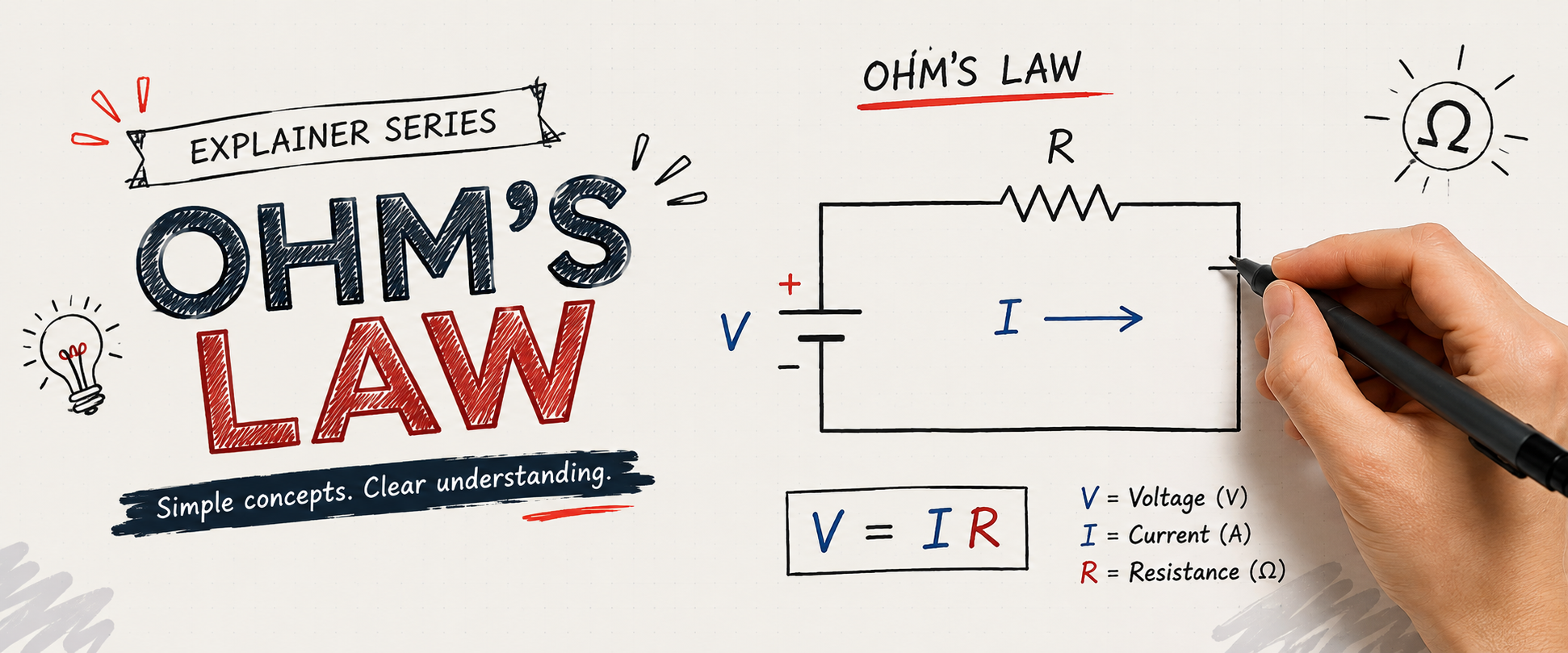
There’s a fourth quantity you don’t see on labels: resistance, measured in ohms (Ω). It’s how hard a thing fights the flow — a narrow pipe, a kink in the hose. Every wire, bulb and heating coil has some.
Ohm found that push, flow and fight are locked together:
Volts = Amps × Resistance — or V = I × R
Read it the useful way round: I = V ÷ R. Volts and resistance are what you set; amps are what you get.
- Turn up the volts → more amps.
- Add resistance → fewer amps.
An air fryer is just a heating element with a chosen resistance. The maker picked it so that at 240 V, roughly 8 A flows and you get 2000 W of heat. That’s the entire design.
The safety half
The dangerous direction is less resistance → more current. A short circuit is a path with almost no resistance; amps shoot up, wires heat instantly, and that’s what fuses and breakers exist to stop. A frayed cord, a plug loose in the socket, a cable squashed under a sofa — each adds a bad spot of resistance, and that spot gets hot. A warm plug is a warning, not normal.
Same rule, small scale: an LED on its own has almost no resistance once lit. Straight across a battery it draws a huge current and dies in a blink. Add a resistor and it lives — the resistor sets the current to what the LED can take. That’s what nearly every resistor in every circuit is doing.
Part 3 — Watch it happen
The simulator alongside this article is a toy version of your house: a battery you can set from 0 to 12 V, a switch, a knob that adds resistance (0–50 Ω), a bulb rated 9 V / 0.30 A, and two meters — one for amps in the loop, one for volts across the bulb. It shows the sum it’s doing every time you move a slider.
Series loop · Ammeter in series · Voltmeter across bulb
30 Ω rated 9 V / 0.30 A (blows > 0.36 A).Total
R = 30 Ω + Rvar. Try 12 V with resistor at 0 Ω.
Close the switch. Nothing flows until the loop is complete. At the defaults — 6 V battery, knob at 10 Ω — the bulb lights and the meter reads 0.15 A. Dim, but on.
Push the voltage up. Crank the battery to 12 V. Current climbs to 0.30 A — exactly the bulb’s rating — and it hits full brightness. More push, more flow.
Push the resistance knob up. Turn it to 50 Ω. Current falls back to 0.15 A and the bulb dims, even though the battery hasn’t moved. More resistance, less flow. Watch the voltmeter too — the bulb’s share of the voltage falls as the knob takes more of it.
Blow it. Resistance to zero, voltage at 12 V. The bulb, rated for 0.30 A, is now pushing 12 ÷ 30 = 0.40 A — past the 0.36 A limit. Flash — filament gone. The ammeter drops to zero; the voltmeter now reads the full 12 V sitting across the broken gap. That’s the power strip cooking, in miniature.
Fix it with resistance. Hit Replace bulb. Leave the battery at a full 12 V — too much for the bulb on its own — but set the knob to 10 Ω. Current: 12 ÷ (30 + 10) = 0.30 A. Bulb happy, voltmeter reads exactly 9 V. The knob is soaking up the extra 3 V.
That last step is the whole lesson. Resistance isn’t waste; it’s how you keep current inside what things can survive — whether that’s a resistor by an LED, a fuse in a plug, or a sensibly thick cable.
What you now know
- Amps = Watts ÷ 240. About 4 A per 1000 W.
- A 13 A socket handles about 3100 W total. Add up everything on the strip.
- Heat-makers get their own socket.
- I = V ÷ R. Volts push, resistance fights, amps are the result.
- Less resistance → more current → more heat. Fuses trip on current.
- Warm plug or cable? Unplug it and find out why.
| Want to know… | Use |
|---|---|
| Amps | I = V ÷ R, or W ÷ V |
| Volts | V = I × R |
| Resistance | R = V ÷ I |
| Watts | P = V × I |
Footnote for the curious: real filaments change resistance as they heat, and LEDs don’t follow a straight line at all. The simulator keeps the bulb at a fixed 30 Ω so the arithmetic stays clean. Ohm’s law is still the first thing you reach for.